Zigbee 24G mmWave Human Presence and Motion Sensor
Official Store Deal
Expert Analysis Overview
Precision in Perception: The 24G mmWave Automation Catalyst
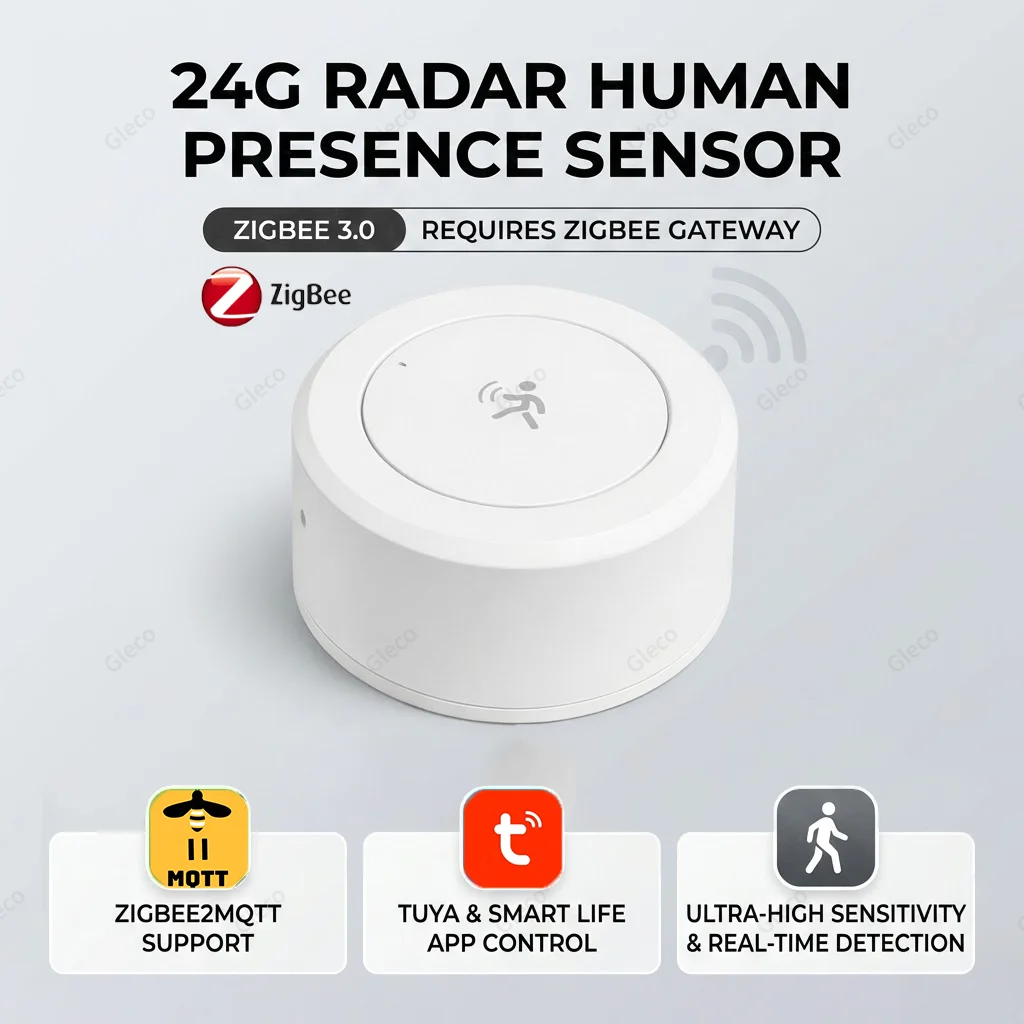
The Zigbee 24G mmWave Human Presence and Motion Sensor stands as a pivotal component for the discerning home automation engineer, delivering an unparalleled level of environmental awareness. This device is specifically engineered for advanced smart home ecosystems, targeting users who demand meticulous control and comprehensive occupancy detection beyond the capabilities of conventional sensors. Its fundamental advantage lies in its sophisticated ability to detect not just motion, but also the subtle, static presence of individuals, fundamentally transforming how automated routines interact with living spaces.
The Dawn of True Occupancy: mmWave Radar Mechanics
Traditional occupancy sensors, primarily Passive Infrared (PIR) detectors, rely on changes in infrared radiation emitted by moving bodies. While effective for detecting broad movements, their inherent design limitation means they fail to register a person who is stationary. This often leads to frustrating scenarios where lights extinguish prematurely, or climate control systems revert to energy-saving modes, despite a room still being occupied. Such occurrences are a common pain point in many smart home setups.
The 24G mmWave radar technology employed by this sensor operates on an entirely different principle. It continuously emits high-frequency millimeter waves into its detection zone. These waves then reflect off objects and surfaces, returning to the sensor. The sensor's sophisticated processing unit analyzes minute phase shifts and frequency changes in these reflected waves. These imperceptible shifts are caused by even the slightest movements, such as the rhythmic expansion and contraction of a chest during breathing, or the subtle shifting of weight by someone reading a book. The sensor picks up these micro-motions.
This advanced methodology provides a significant upgrade over thermal-based detection. It ensures that the sensor can accurately determine if a human is present in a room, regardless of their activity level. This comprehensive detection capability, encompassing both active motion and static presence, is crucial for creating truly intelligent and responsive automation. It eliminates the guesswork.
Architectural Backbone: Zigbee's Robust Foundation
Effective communication is paramount in any distributed system. This sensor integrates the Zigbee 3.0 protocol, a widely adopted standard for low-power, mesh-networked smart home devices. Zigbee creates a mesh network, allowing devices to relay signals to one another, extending the network's effective range and enhancing overall system reliability. Should one device drop offline, others can route around it.
For the dedicated Home Assistant user, the inclusion of Zigbee2MQTT (Z2M) support in specific versions is a game-changer. Z2M acts as a bridge, allowing Zigbee devices to communicate directly with an MQTT broker, which Home Assistant can then subscribe to. This architecture facilitates local control, minimizing reliance on external cloud services. Local control offers superior privacy, reduced latency, and continued functionality even during internet outages. Data stays within the local network.
Conversely, the availability of Tuya Smart Life app support in other versions caters to a broader consumer base. Tuya offers a comprehensive, albeit cloud-centric, smart home ecosystem with a user-friendly application for device management and automation rule creation. While it may lack the granular local control of Z2M, it provides a straightforward path to integrating the sensor into an existing Tuya-based smart home. This dual-path approach ensures broad market applicability.
The Art of Refinement: Configurable Detection Parameters
A key differentiator for this mmWave sensor is its capacity for detailed configuration. Depending on the specific version and integrated platform, users can precisely adjust critical radar parameters. These include the detection distance and the sensitivity level. Such fine-tuning is not merely a convenience; it is essential for optimal performance.
This granular control allows for the creation of highly customized detection zones. For example, in a small bathroom, the detection range might be limited to the bed area to avoid triggering lights when someone merely walks past the door. In a home office, a higher sensitivity could be set to capture the subtle movements of a person working at a desk, ensuring continuous presence detection. This adaptability is vital.
The ability to tailor these settings addresses common challenges with generic motion sensors, such as false positives triggered by pets, or false negatives in areas with minimal movement. By allowing users to define the sensor's operational envelope, the device provides a level of intelligence that transcends simple binary detection. It ensures that automation logic is based on genuinely relevant data, leading to a significantly improved user experience. It ensures accurate sensing.
Thoughtful Integration: Design and Placement Dynamics
The physical form factor of the sensor is designed for discreet integration. Its compact, circular, and unassuming white casing ensures it blends seamlessly into a variety of interior decors. The absence of prominent lenses or intrusive elements maintains a clean aesthetic.
Strategic placement is paramount for maximizing the sensor's efficacy. While it can be wall-mounted, ceiling mounting often provides the most comprehensive and unobstructed view of a room. This overhead perspective allows the radar waves to propagate effectively, covering a wider area and reducing potential blind spots caused by furniture or structural elements. The sensor needs a clear field.
When considering deployment, users should account for potential sources of interference. While mmWave radar is generally robust, direct exposure to strong electromagnetic fields or significant structural obstructions might subtly affect performance. Careful planning of the installation location, considering the room's layout and typical human activity patterns, will yield the best results. It is a subtle art.
Navigating the Ecosystem Divide: Version Specifics
One of the most crucial considerations for potential implementers is the product's distinct versioning. The provided comparison matrix clearly outlines multiple "Types," each with specific protocol affiliations. This is not a minor detail but a fundamental architectural choice.
For instance, the Z2M-compatible versions are explicitly designed for integration with Zigbee2MQTT and, by extension, systems like Home Assistant that leverage MQTT. These versions are explicitly stated as incompatible with the Tuya Smart Life app. Conversely, the Tuya Zigbee versions are tailored for the Tuya ecosystem and require a Tuya Zigbee gateway. This strict segregation ensures optimized performance within their respective platforms but demands careful pre-purchase selection. Choosing wisely is essential.
This strategic fragmentation, while demanding user attention, reflects the diverse landscape of smart home preferences. It allows the manufacturer to cater to both the open-source, local-control-focused community and the broader, app-centric consumer market. Understanding these critical distinctions prior to acquisition is absolutely necessary to avoid compatibility frustrations and ensure a smooth integration process.
Beyond Motion: Advanced Automation and Security Protocols
The capabilities of the 24G mmWave sensor extend far beyond simple convenience, fundamentally enhancing both automation logic and security postures within a smart home. Its ability to detect a person's sustained presence, even when motionless, closes significant gaps in traditional security systems. An intruder attempting to remain still to evade detection would still register on this advanced sensor. This offers a higher level of vigilance.
The sensor unlocks a new echelon of multi-scene linkage for dynamic home automation. Consider a scenario in a bathroom: upon entry, the sensor detects presence, instantly activating lighting and perhaps a ventilation fan. These services remain active for the duration of occupancy, only deactivating a set time after the room is confirmed empty. This eliminates the common annoyance of lights switching off while someone is still showering or using the facilities. The system truly understands.
This advanced presence detection allows for highly sophisticated, condition-based automation rules. For example, a rule could be established: "If 'person present' in the living room between 10 PM and 6 AM, and main lights are off, then activate a soft, low-level pathway light." Or, for energy management: "If 'no person present' in the office for 30 minutes during working hours, then lower thermostat setpoint by 2 degrees and turn off monitor." This level of intelligent control provides both enhanced comfort and significant energy savings. It transforms a house into a responsive dwelling.
The Evolution of Smart Living: A Forward-Looking Perspective
The Zigbee 24G mmWave Human Presence and Motion Sensor represents a significant evolutionary step in smart home sensing technology. Its precision, adaptability, and robust Zigbee connectivity empower home automation engineers and enthusiasts to construct truly intelligent and highly responsive living environments. The era of frustrating false negatives, premature light shutdowns, or unresponsive climate control is effectively being phased out. This advanced technology ensures that a home can genuinely anticipate and adapt to its occupants' needs, seamlessly responding to their presence, whether they are actively moving or simply enjoying a moment of stillness. Imagine a personal space that intuitively understands occupancy, meticulously optimizing comfort, security, and energy efficiency without requiring constant manual intervention. This sensor delivers that promise, integrating effortlessly into a sophisticated, highly responsive smart home ecosystem, ensuring every interaction is fluid, logical, and tailored to the moment. Your home becomes a truly intelligent and adaptive partner.