Zigbee MmWave Human Presence & Environmental Sensor
Official Store Deal
Expert Analysis Overview
The Zigbee MmWave Human Presence & Environmental Sensor is a sophisticated multi-sensor device engineered for advanced home automation enthusiasts seeking granular control and robust environmental monitoring. This compact unit integrates several critical detection capabilities into a single, unobtrusive form factor, providing a foundation for truly intelligent living spaces. Its adherence to the Zigbee protocol ensures seamless integration into existing smart home ecosystems, prioritizing reliability and local processing.
This sensor operates on the Zigbee 3.0 standard, a crucial detail for any serious home automation setup. It boasts broad compatibility, working effortlessly with popular platforms such as Tuya Smart Life, Zigbee2MQTT, and Home Assistant. This versatility means users aren't locked into a single ecosystem, offering flexibility for future expansion or migration.
Zigbee, for those unfamiliar, establishes a low-power, wireless mesh network. Devices communicate with each other, extending the network's reach and enhancing reliability. Unlike Wi-Fi devices that often rely on cloud servers for basic functionality, Zigbee devices can operate locally, reducing latency and bolstering privacy. This sensor benefits immensely from this architecture, ensuring commands are executed swiftly and data remains within the local network.
The inclusion of Zigbee2MQTT support is a significant advantage, particularly for power users and privacy advocates. This integration allows the sensor to communicate directly with an MQTT broker, effectively decoupling it from the Tuya cloud infrastructure. This provides true local control, faster response times, and enhanced data privacy, representing a substantial upgrade over standard cloud-dependent smart home devices. It’s a clear differentiator for those building resilient, self-contained automation systems.
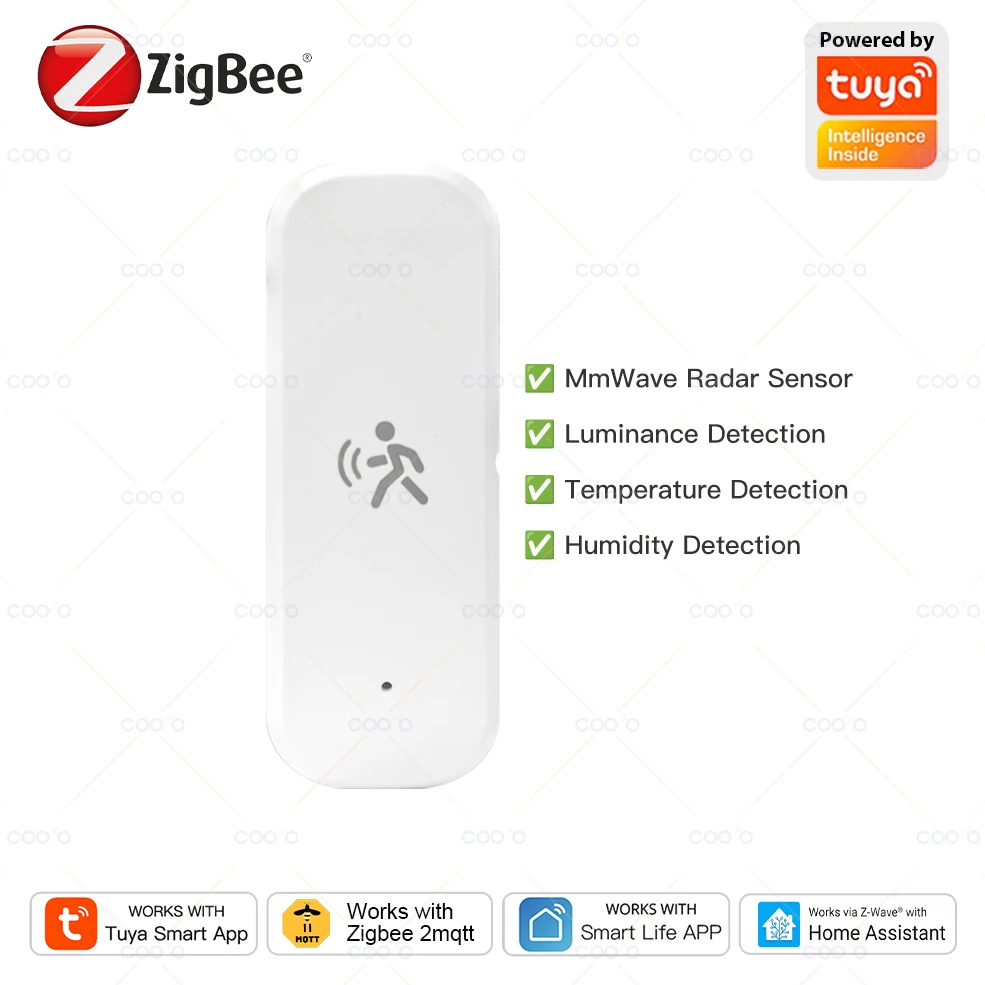
At the heart of this device is a 10G MmWave radar sensor, a technology that fundamentally redefines occupancy detection. This advanced radar system offers a 110-degree detection angle and an adjustable range from 0.5 to 10 meters. Crucially, it detects not just gross motion, but subtle human presence.
MmWave technology works by emitting millimeter waves and analyzing their reflections. Unlike traditional Passive Infrared (PIR) sensors that only detect changes in infrared radiation (i.e., moving heat signatures), MmWave radar can detect micro-movements, such as breathing or slight shifts in posture. This means the sensor can accurately determine if a person is present in a room even if they are sitting perfectly still, reading a book, or watching television. Imagine a scenario where the lights in your study never turn off unexpectedly because you've been motionless for too long; this is the promise of MmWave.
Compared to conventional PIR sensors, which are prone to false negatives when occupants are stationary, MmWave radar offers superior accuracy in occupancy detection. This elevates smart lighting, climate control, and security automations to a new level of precision. It moves beyond simple motion detection to genuine human presence detection, a critical evolution for sophisticated smart environments.
Beyond its advanced presence detection, this unit functions as a true 4-in-1 environmental sensor. It integrates capabilities for luminance detection, temperature detection, and humidity detection. This comprehensive suite of sensors provides a rich dataset for creating highly contextual smart home automations.
The real-world impact of these integrated sensors is profound. With luminance data, automated blinds can adjust based on the intensity of natural light, or smart lighting can dim or brighten to maintain a consistent ambiance. Temperature and humidity readings allow for intelligent HVAC adjustments, ensuring optimal climate control and comfort without constant manual intervention. Picture a living room where the fan automatically activates when humidity rises above a certain threshold, or the thermostat intelligently pre-cools based on anticipated occupancy and external temperature changes.
This integrated approach offers significant advantages over deploying multiple single-function sensors. It streamlines installation, reduces visual clutter, and simplifies data collection, presenting a unified environmental profile of any given space. Instead of managing several disparate data streams, all relevant environmental metrics are consolidated into one intelligent device, enhancing the overall efficiency and responsiveness of the smart home system.
The sensor's 110° detection angle is complemented by an adjustable 0.5-10m detection distance. This allows for fine-tuning the sensor's sensitivity, effectively defining high and low sensitivity zones. This level of control is paramount for optimizing automation routines and preventing unintended triggers.
Customization options are essential for adapting the sensor to diverse room layouts and specific use cases. For instance, in a hallway, the sensitivity can be reduced to prevent activation from distant movements in an adjacent room. Conversely, in a large open-plan office or living area, the detection range can be maximized to ensure comprehensive coverage. This flexibility ensures the sensor acts precisely where needed, avoiding unnecessary activations and conserving energy.
This granular control over detection parameters is often a missing feature in many off-the-shelf motion sensors. It provides the home automation engineer with the precision required to craft intricate and reliable automation sequences, ensuring that lights, climate systems, or security alerts respond exactly as intended, tailored to the unique dynamics of each space.
One of the inherent benefits of the Zigbee protocol is its inherently low latency, which translates directly into rapid sensor response. This is a critical performance metric for any automation system, particularly for applications like smart lighting or security alerts. A sensor's ability to react almost instantaneously is what separates a truly smart home from a merely automated one.
For lighting automation, low latency is non-negotiable. The expectation is that lights illuminate *as* a person enters a room, not after a noticeable delay that disrupts the user experience. With this Zigbee sensor, the time between detection and action is minimized, creating a fluid and natural interaction with the environment. In security contexts, immediate alerts are paramount, and the sensor's quick response time contributes significantly to a robust security posture.
The direct, local communication path afforded by Zigbee, especially when integrated via Zigbee2MQTT, bypasses the delays associated with cloud processing. This results in significantly faster reaction times compared to many Wi-Fi-based alternatives, where data often travels to a remote server and back before an action is triggered. This efficiency is a core tenet of effective home automation.
Visually, the sensor presents itself with a matte white finish and a compact, rectangular form factor. Its minimalist aesthetic is designed to blend seamlessly into various interior decors without drawing undue attention. The plastic enclosure feels dense and well-assembled, not hollow or flimsy, suggesting thoughtful construction.
This discreet design ensures that the sensor can be installed in prominent locations, such as ceilings or walls, without becoming an eyesore. Its unobtrusive nature allows it to perform its advanced functions in the background, maintaining a clean and modern aesthetic within any living or working space. The absence of excessive branding or flashing lights contributes to its subtle integration.
The minimalist design reflects a focus on core functionality and integration, rather than flashy aesthetics. This approach is characteristic of robust smart home components that prioritize reliability and longevity. The tactile impression is one of a solid, functional device engineered for consistent performance.
This device's primary value lies in its ability to combine multiple critical sensors into a single, cohesive unit. Instead of purchasing and installing separate devices for presence, light, temperature, and humidity, this sensor consolidates these functions, simplifying deployment and management.
This integration significantly reduces Hardware clutter and streamlines the installation process. For a comprehensive monitoring solution, fewer devices mean less wiring, fewer batteries to manage (if applicable), and a more unified data stream for automation logic. The long-term value extends to potential energy savings through more precise climate and lighting control, as well as enhanced comfort and security from accurate presence detection. It is an investment in a more intelligent and responsive home.
Investing in a multi-functional Zigbee device like this offers a higher return on investment than acquiring several single-purpose sensors. It not only reduces upfront costs and installation complexity but also provides a more holistic view of the environment, enabling more sophisticated and efficient automations in the long run. This consolidated approach is a smart choice for optimizing any smart home ecosystem.
Imagine walking into a room, and the lights gently illuminate precisely as you cross the threshold, adjusted perfectly to the ambient light. The air conditioning subtly recalibrates as the temperature rises, and the humidity levels are always within comfort parameters. This sensor forms the intelligent backbone of a truly responsive and energy-efficient living space, reacting to your presence and environmental shifts with seamless precision.
Unpacking the Connectivity Core
This sensor operates on the Zigbee 3.0 standard, a crucial detail for any serious home automation setup. It boasts broad compatibility, working effortlessly with popular platforms such as Tuya Smart Life, Zigbee2MQTT, and Home Assistant. This versatility means users aren't locked into a single ecosystem, offering flexibility for future expansion or migration.
Zigbee, for those unfamiliar, establishes a low-power, wireless mesh network. Devices communicate with each other, extending the network's reach and enhancing reliability. Unlike Wi-Fi devices that often rely on cloud servers for basic functionality, Zigbee devices can operate locally, reducing latency and bolstering privacy. This sensor benefits immensely from this architecture, ensuring commands are executed swiftly and data remains within the local network.
The inclusion of Zigbee2MQTT support is a significant advantage, particularly for power users and privacy advocates. This integration allows the sensor to communicate directly with an MQTT broker, effectively decoupling it from the Tuya cloud infrastructure. This provides true local control, faster response times, and enhanced data privacy, representing a substantial upgrade over standard cloud-dependent smart home devices. It’s a clear differentiator for those building resilient, self-contained automation systems.
The Precision of MmWave Radar
At the heart of this device is a 10G MmWave radar sensor, a technology that fundamentally redefines occupancy detection. This advanced radar system offers a 110-degree detection angle and an adjustable range from 0.5 to 10 meters. Crucially, it detects not just gross motion, but subtle human presence.
MmWave technology works by emitting millimeter waves and analyzing their reflections. Unlike traditional Passive Infrared (PIR) sensors that only detect changes in infrared radiation (i.e., moving heat signatures), MmWave radar can detect micro-movements, such as breathing or slight shifts in posture. This means the sensor can accurately determine if a person is present in a room even if they are sitting perfectly still, reading a book, or watching television. Imagine a scenario where the lights in your study never turn off unexpectedly because you've been motionless for too long; this is the promise of MmWave.
Compared to conventional PIR sensors, which are prone to false negatives when occupants are stationary, MmWave radar offers superior accuracy in occupancy detection. This elevates smart lighting, climate control, and security automations to a new level of precision. It moves beyond simple motion detection to genuine human presence detection, a critical evolution for sophisticated smart environments.
A Comprehensive Environmental Hub
Beyond its advanced presence detection, this unit functions as a true 4-in-1 environmental sensor. It integrates capabilities for luminance detection, temperature detection, and humidity detection. This comprehensive suite of sensors provides a rich dataset for creating highly contextual smart home automations.
The real-world impact of these integrated sensors is profound. With luminance data, automated blinds can adjust based on the intensity of natural light, or smart lighting can dim or brighten to maintain a consistent ambiance. Temperature and humidity readings allow for intelligent HVAC adjustments, ensuring optimal climate control and comfort without constant manual intervention. Picture a living room where the fan automatically activates when humidity rises above a certain threshold, or the thermostat intelligently pre-cools based on anticipated occupancy and external temperature changes.
This integrated approach offers significant advantages over deploying multiple single-function sensors. It streamlines installation, reduces visual clutter, and simplifies data collection, presenting a unified environmental profile of any given space. Instead of managing several disparate data streams, all relevant environmental metrics are consolidated into one intelligent device, enhancing the overall efficiency and responsiveness of the smart home system.
Granular Control Over Detection
The sensor's 110° detection angle is complemented by an adjustable 0.5-10m detection distance. This allows for fine-tuning the sensor's sensitivity, effectively defining high and low sensitivity zones. This level of control is paramount for optimizing automation routines and preventing unintended triggers.
Customization options are essential for adapting the sensor to diverse room layouts and specific use cases. For instance, in a hallway, the sensitivity can be reduced to prevent activation from distant movements in an adjacent room. Conversely, in a large open-plan office or living area, the detection range can be maximized to ensure comprehensive coverage. This flexibility ensures the sensor acts precisely where needed, avoiding unnecessary activations and conserving energy.
This granular control over detection parameters is often a missing feature in many off-the-shelf motion sensors. It provides the home automation engineer with the precision required to craft intricate and reliable automation sequences, ensuring that lights, climate systems, or security alerts respond exactly as intended, tailored to the unique dynamics of each space.
Responsive Automation with Low Latency
One of the inherent benefits of the Zigbee protocol is its inherently low latency, which translates directly into rapid sensor response. This is a critical performance metric for any automation system, particularly for applications like smart lighting or security alerts. A sensor's ability to react almost instantaneously is what separates a truly smart home from a merely automated one.
For lighting automation, low latency is non-negotiable. The expectation is that lights illuminate *as* a person enters a room, not after a noticeable delay that disrupts the user experience. With this Zigbee sensor, the time between detection and action is minimized, creating a fluid and natural interaction with the environment. In security contexts, immediate alerts are paramount, and the sensor's quick response time contributes significantly to a robust security posture.
The direct, local communication path afforded by Zigbee, especially when integrated via Zigbee2MQTT, bypasses the delays associated with cloud processing. This results in significantly faster reaction times compared to many Wi-Fi-based alternatives, where data often travels to a remote server and back before an action is triggered. This efficiency is a core tenet of effective home automation.
Unobtrusive Design and Build Quality
Visually, the sensor presents itself with a matte white finish and a compact, rectangular form factor. Its minimalist aesthetic is designed to blend seamlessly into various interior decors without drawing undue attention. The plastic enclosure feels dense and well-assembled, not hollow or flimsy, suggesting thoughtful construction.
This discreet design ensures that the sensor can be installed in prominent locations, such as ceilings or walls, without becoming an eyesore. Its unobtrusive nature allows it to perform its advanced functions in the background, maintaining a clean and modern aesthetic within any living or working space. The absence of excessive branding or flashing lights contributes to its subtle integration.
The minimalist design reflects a focus on core functionality and integration, rather than flashy aesthetics. This approach is characteristic of robust smart home components that prioritize reliability and longevity. The tactile impression is one of a solid, functional device engineered for consistent performance.
The Value Proposition of Integration
This device's primary value lies in its ability to combine multiple critical sensors into a single, cohesive unit. Instead of purchasing and installing separate devices for presence, light, temperature, and humidity, this sensor consolidates these functions, simplifying deployment and management.
This integration significantly reduces Hardware clutter and streamlines the installation process. For a comprehensive monitoring solution, fewer devices mean less wiring, fewer batteries to manage (if applicable), and a more unified data stream for automation logic. The long-term value extends to potential energy savings through more precise climate and lighting control, as well as enhanced comfort and security from accurate presence detection. It is an investment in a more intelligent and responsive home.
Investing in a multi-functional Zigbee device like this offers a higher return on investment than acquiring several single-purpose sensors. It not only reduces upfront costs and installation complexity but also provides a more holistic view of the environment, enabling more sophisticated and efficient automations in the long run. This consolidated approach is a smart choice for optimizing any smart home ecosystem.
Imagine walking into a room, and the lights gently illuminate precisely as you cross the threshold, adjusted perfectly to the ambient light. The air conditioning subtly recalibrates as the temperature rises, and the humidity levels are always within comfort parameters. This sensor forms the intelligent backbone of a truly responsive and energy-efficient living space, reacting to your presence and environmental shifts with seamless precision.